How to Cut Energy Costs in Industrial Drying Processes
1. Introduction
Industrial drying is one of the most energy-consuming unit operations across manufacturing sectors, including food processing, pharmaceuticals, chemicals, agriculture, and new materials. It relies on continuous heating, airflow circulation, and moisture evaporation, resulting in high thermal and electrical energy consumption. Statistics show that drying processes often account for 15%–25% of total factory energy usage, with most systems operating at low energy efficiency due to unreasonable parameter settings, wasted exhaust heat, outdated equipment, and mismatched operation modes. Rising energy prices and stricter carbon emission standards have made energy cost reduction a core priority for drying production optimization. This article summarizes practical, cost-effective strategies to cut energy costs in industrial drying, covering operational optimization, equipment upgrading, heat recovery, and intelligent control, helping enterprises reduce operating expenses while maintaining stable product quality.
2. Optimize Drying Operation Parameters and Workflows
Most energy waste in drying processes stems from improper manual operation and unreasonable parameter matching. Fine-tuning basic operating settings requires no large investment and delivers immediate energy-saving effects, serving as the most cost-effective optimization method.
2.1 Implement staged temperature and airflow control
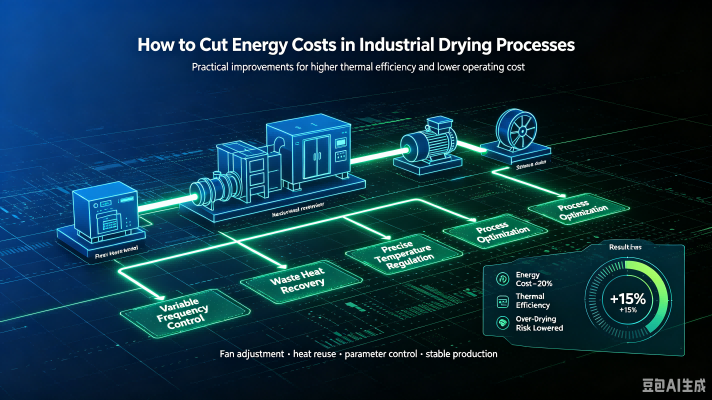
All drying processes follow a fixed moisture evaporation curve, divided into a constant-rate drying stage and a falling-rate drying stage. In the early constant-rate stage, high temperature and strong airflow are required to quickly remove surface moisture; in the later falling-rate stage, excessive temperature and fan speed only cause energy waste and may damage heat-sensitive materials. Enterprises can set segmented temperature and airflow parameters according to material characteristics, lowering heating temperature and reducing fan operating power in the late drying phase. This simple adjustment can reduce comprehensive energy consumption by 8%–15% without affecting drying efficiency.
2.2 Avoid over-drying and realize precise moisture control
To avoid unqualified products caused by insufficient drying, many factories adopt excessive drying strategies, resulting in huge energy waste. Real-time moisture detection sensors can be installed inside drying equipment to monitor material moisture dynamically. The system automatically stops heating and discharging materials once the standard moisture content is reached, eliminating over-drying energy loss. Relevant data shows that precise moisture control can save up to 20% of thermal energy consumption in batch drying production.
2.3 Optimize material loading and batch arrangement
Unreasonable loading is a common hidden energy waste. Overloading materials leads to uneven hot air circulation and prolonged drying cycles; underloading causes low equipment utilization and wasted unit energy. Standardizing material stacking density, tray spacing, and single-batch loading capacity ensures uniform hot air flow and maximum equipment load rate. Meanwhile, centralized batch production is recommended to reduce frequent equipment startup and shutdown, as repeated heating from cold status consumes far more energy than continuous stable operation.
3. Upgrade Airflow and Power System Configuration
Fans and air supply systems are the main electrical consumers of drying equipment. Traditional fixed-frequency fans run at full power throughout the process, regardless of actual drying demands, causing serious power waste. Upgrading power and airflow systems is a key measure to reduce long-term electricity costs.
3.1 Install Variable Frequency Drives (VFDs) for fans
Retrofitting drying system fans with VFDs enables dynamic speed adjustment according to real-time humidity, temperature, and drying stage changes. Instead of constant full-speed operation, the fan automatically reduces speed and air volume in the late drying stage or low-load production. VFD transformation can reduce fan power consumption by 15%–30% with a short payback period, usually within 3–8 months, making it one of the most popular energy-saving renovations for industrial drying equipment.
3.2 Optimize air duct structure and reduce wind resistance
Aging, blocked, or unreasonably designed air ducts increase airflow resistance, requiring more fan power to maintain normal air volume and causing heat loss. Regular cleaning of air duct dust and material residues, smoothing duct corners, and eliminating air leakage points can effectively reduce wind resistance and hot air loss. Optimized air duct layout improves hot air utilization efficiency by 10% or more, reducing invalid energy consumption caused by airflow attenuation and heat leakage.
4. Adopt Waste Heat Recovery and Heat Pump Technology
Traditional drying equipment directly discharges high-temperature humid exhaust gas, which carries a large amount of waste heat and is the biggest source of thermal energy waste. Recycling waste heat and applying high-efficiency heat pump systems can drastically reduce heating energy consumption.
4.1 Exhaust waste heat recovery system
Installing heat exchangers in drying exhaust channels can capture waste heat from discharged humid air and preheat the fresh cold air entering the drying chamber. This greatly reduces the heating load of the heating system. Mature waste heat recovery equipment can recover 10%–25% of wasted thermal energy, cutting fuel or electric heating costs significantly. For continuous drying production lines, the energy-saving effect is more prominent, realizing cascade utilization of thermal energy.
4.2 Heat pump drying technology replacement
Compared with traditional electric heating, gas heating, and steam drying, heat pump drying systems feature high energy efficiency and low energy consumption. Heat pumps do not directly generate heat but transfer low-temperature heat in the air to the drying chamber, with an energy efficiency ratio 3–4 times that of traditional heating methods. Replacing traditional drying equipment with heat pump dryers can reduce overall energy consumption by 20%–40%. In addition, heat pump drying operates at low and constant temperatures, which also improves the appearance quality and yield of finished materials.
5. Apply Intelligent Automatic Control Systems
Manual operation relies on experience judgment, leading to unstable parameters and frequent energy waste. Intelligent automatic control systems can realize precise, unmanned regulation of the entire drying process, maximizing energy utilization efficiency.
5.1 Real-time intelligent parameter linkage control
The intelligent system integrates temperature, humidity, air volume, and moisture sensors to form a closed-loop control loop. It dynamically adjusts heating power, fan speed, and exhaust volume according to real-time drying status, ensuring that all parameters always operate in the most energy-efficient range. This linkage control avoids energy waste caused by manual over-regulation and maintains consistent drying quality across batches.
5.2 Adaptive load sensing adjustment
Advanced intelligent drying equipment is equipped with adaptive load sensing functions. The system automatically identifies material loading capacity and initial moisture content, independently formulates optimal drying curves, and adjusts energy input in real time. It solves the problem of fixed parameter operation mismatched with variable production conditions, further reducing invalid energy loss and achieving energy-saving production throughout the whole process.
6. Regular Equipment Maintenance and Aging Renewal
Equipment aging and incomplete maintenance will gradually reduce drying efficiency and increase energy consumption. Long-term operation leads to scaling of heating components, blockage of distribution plates, aging of sealing strips, and reduced heat conduction efficiency, forcing the equipment to consume more energy to reach the standard drying effect.
Establishing a regular maintenance mechanism includes cleaning heating components and mesh plates, replacing aging sealing parts to prevent hot air leakage, calibrating temperature and humidity sensors, and overhauling fan and air supply systems. Timely maintenance can restore equipment design operating efficiency and reduce energy consumption by 5%–10%. For severely aging, low-efficiency old equipment, targeted renewal and elimination can fundamentally solve the problem of high energy consumption and create long-term energy-saving benefits.
7. Select Matched Drying Equipment According to Material Characteristics
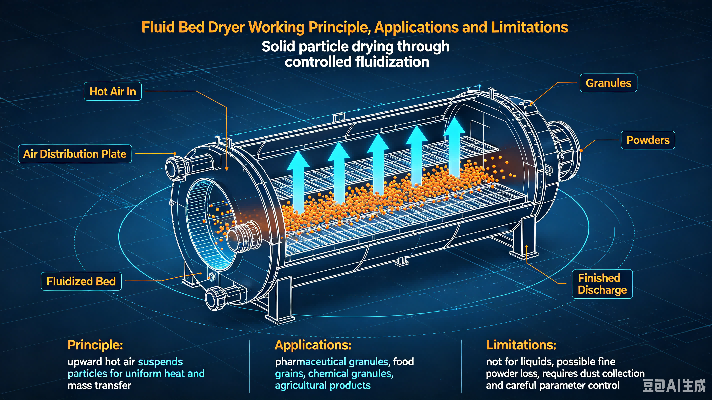
Many enterprises use universal drying equipment for all materials, resulting in low energy efficiency. Different materials have distinct physical properties such as particle size, fluidity, viscosity, and heat sensitivity, requiring matched drying processes and equipment. For fluid granular materials, fluid bed dryers with high heat and mass transfer efficiency are preferred; for heat-sensitive food and pharmaceutical materials, low-temperature heat pump drying is more energy-saving; for bulk and high-moisture materials, continuous drying lines are more efficient than intermittent tray dryers. Scientific equipment selection can avoid energy waste caused by equipment-material mismatch and greatly improve overall production energy efficiency.
8. Conclusion
Cutting energy costs in industrial drying processes is a systematic project covering operational optimization, technological transformation, intelligent upgrading, and daily maintenance. Enterprises can start with low-cost and zero-cost measures such as parameter optimization, standardized operation, and equipment maintenance to achieve immediate energy-saving effects. On this basis, gradually carry out VFD fan transformation, waste heat recovery system installation, and intelligent control upgrading to realize long-term energy consumption reduction. Reasonable matching of equipment and materials, combined with refined process management, can not only effectively reduce production costs and improve economic benefits, but also reduce carbon emissions and realize green and sustainable manufacturing.