Spray Dryer vs. Fluid Bed Dryer: How to Choose the Right One
1. Introduction
Spray dryers and fluid bed dryers are two of the most widely used industrial drying equipment in pharmaceutical, food, chemical, agricultural, and new material industries. Both devices achieve efficient moisture removal and particle processing, but they differ fundamentally in working principle, feed material form, finished particle characteristics, energy consumption, and applicable production scenarios.
Many manufacturers face confusion in equipment selection: choosing the wrong dryer will lead to unqualified particle quality, low production efficiency, excessive material waste, and increased operating costs. This article systematically compares spray dryers and fluid bed dryers, elaborates their core advantages, limitations, and suitable applications, and provides a clear selection guide to help enterprises match the most appropriate drying equipment according to material properties and production requirements.
2. Basic Working Principle Differences
2.1 Spray Dryer Working Principle
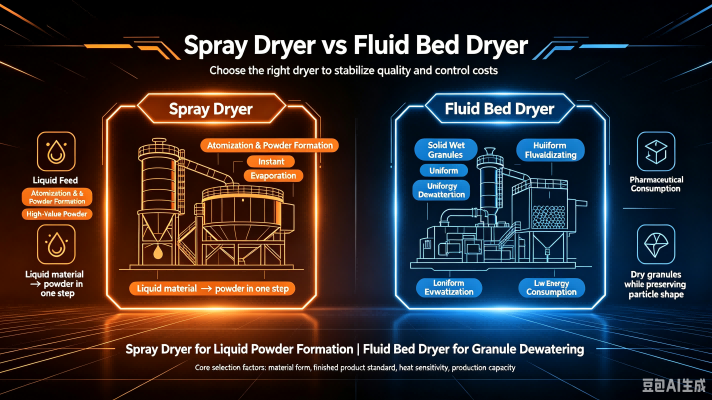
A spray dryer is a one-step rapid drying device for liquid materials. It atomizes liquid feedstock such as solutions, suspensions, slurries, and extracts into tiny micro-droplets through a high-speed atomizer. These fine droplets fully contact with high-temperature hot air in the vertical drying tower, completing water evaporation and solid-liquid separation in an extremely short time (1–3 seconds). The material is directly converted from liquid state into dry fine powder or spherical particles, realizing one-step molding without intermediate procedures.
2.2 Fluid Bed Dryer Working Principle
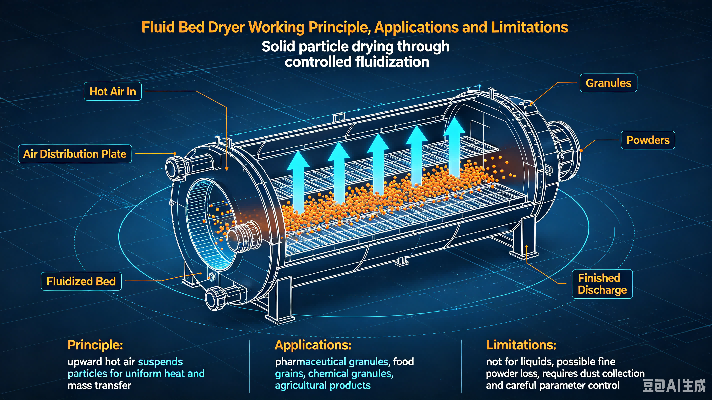
A fluid bed dryer is a dynamic drying device for solid granular and powdery materials. It sends uniform upward hot airflow to lift and suspend pre-made wet granules or powders, forming a boiling fluidized state. Each particle is fully wrapped and heated by hot air, achieving uniform heat and mass transfer. The equipment mainly removes residual moisture from solid materials, completing even drying through continuous fluidization circulation without changing the basic particle shape of the raw materials.
3. Core Comparison of Key Characteristics
3.1 Feed Material Adaptability
Spray Dryer: Exclusive for liquid, slurry, paste, and solution materials. It processes liquid feedstock directly into powder, making it the optimal choice for liquid extraction and powder forming. It is widely applicable for fruit and vegetable juice extracts, herbal liquid extracts, milk liquid, chemical solvent suspensions, and biological liquid materials.
Fluid Bed Dryer: Exclusive for solid wet granules, powders, and aggregated particles. It only dries pre-formed solid materials and cannot process liquid raw materials. It is suitable for wet granules after pharmaceutical granulation, grain particles, plastic particles, and chemical granular materials with stable particle shapes.
3.2 Finished Product Particle Performance
Spray Dryer: Produces uniform, spherical fine powder with loose texture, good fluidity, and excellent water solubility. Some spray-dried particles present a hollow structure with low bulk density, which is very suitable for fast-dissolving products. The particle size is stable and controllable, with no agglomeration, meeting high-standard powder product requirements.
Fluid Bed Dryer: Maintains the original particle shape of raw materials with high particle hardness and compact structure. The finished granules have good abrasion resistance and uniform internal moisture. However, the particle fluidity and solubility are inferior to spray-dried powder, and fine powder loss may occur during high-speed fluidization.
3.3 Drying Speed and Production Efficiency
Spray Dryer: Ultra-fast instantaneous drying with a residence time of only a few seconds. It supports continuous large-scale production with high hourly output, suitable for high-yield industrial production lines. The one-step molding process simplifies production procedures and improves overall efficiency.
Fluid Bed Dryer: Relatively longer drying cycle with stable and moderate efficiency. It is not suitable for ultra-high-speed continuous forming production but excels in precise drying and moisture adjustment of finished granules, with extremely uniform final moisture content.
3.4 Heat Sensitivity Adaptability
Spray Dryer: Excellent for heat-sensitive materials. Due to instantaneous evaporation cooling, the surface temperature of particles remains low even in high-temperature hot air, avoiding thermal decomposition, activity loss, and color deterioration of heat-sensitive substances such as biological agents, food nutrients, and pharmaceutical active ingredients.
Fluid Bed Dryer: Good heat resistance adaptability with precise temperature control. It is suitable for general heat-sensitive materials but is not ideal for ultra-sensitive materials that cannot withstand long-term hot air flushing due to prolonged particle heating time.
3.5 Energy Consumption and Operating Cost
Spray Dryer: Large equipment footprint, high hot air demand, and high overall energy consumption. The one-time equipment investment and later maintenance cost are relatively high, suitable for large-batch high-value material production.
Fluid Bed Dryer: Higher thermal utilization efficiency, lower invalid heat loss, and lower comprehensive energy consumption. The equipment structure is simple with low failure rate and convenient maintenance, featuring higher cost performance for conventional granular drying.
4. Applicable Industry Scenarios
4.1 Choose a Spray Dryer for These Scenarios
- Raw materials are liquid, slurry, or paste that need direct powder forming
- Finished products require spherical shape, good fluidity, and fast water solubility
- Processing ultra-heat-sensitive materials such as probiotics, plant extracts, and biological powders
- Large-scale continuous industrial production with high output requirements
- Food industry: milk powder, coffee powder, fruit and vegetable powder, seasoning powder
- Chemical industry: dye powder, ceramic powder, nano-material powder
4.2 Choose a Fluid Bed Dryer for These Scenarios
- Raw materials are pre-formed wet granules or solid powders that only require dehumidification and drying
- Finished products require high particle hardness, complete particle shape, and compression resistance
- Pharmaceutical solid preparation production: drying wet granules for tablets and capsules
- Small and medium batch production with strict requirements for moisture uniformity
- Agricultural and chemical granular materials with low requirements for powder fineness and solubility
5. Selection Decision Guide
Select Spray Dryer if your production meets the following conditions:
Feedstock is liquid/slurry; you need one-step powder forming; require fine, uniform, fast-dissolving powder products; process high-value heat-sensitive materials; pursue high-capacity continuous production.
Select Fluid Bed Dryer if your production meets the following conditions:
Feedstock is solid wet granules/powders; only residual moisture removal is needed; require complete particle shape and high hardness; focus on low energy consumption and stable batch moisture; engage in pharmaceutical granule drying and conventional granular material processing.
6. Conclusion
Spray dryers and fluid bed dryers have their own unique advantages and targeted application fields. The core of equipment selection is to match the dryer type according to theraw material form, finished product standard, material heat sensitivity, and production scale. Spray dryers dominate liquid-to-powder forming and high-end fine powder production, while fluid bed dryers excel in solid granule drying, low energy consumption, and high-uniformity dehumidification. Scientific selection can effectively improve production efficiency, stabilize product quality, and reduce comprehensive operating costs for industrial drying production.